
Addiction
Ready to quit nicotine? Dive into quick facts, real tips, and a tool designed to help you break up with nicotine.

Here are the facts about quitting: why it’s better for you and what to expect along the way.
Here are the facts about quitting: why its better for you and what to expect along the way. Hover over each fact to learn more.
Quitting smoking cuts your lung cancer risk compared to those who keep smoking.
Centers for Disease Control and Prevention. (n.d.). Cigarettes and cancer. https://www.cdc.gov/tobacco/about/cigarettes-and-cancer.html#:~:text=The%20risk%20of%20developing%20cancer%20decreases%20over%20time:&text=5%20to%2010%20years%20after,cancer%20drops%20by%20about%20half
Quitting tobacco improves mental health, reducing anxiety, stress, and depression.
Centers for Disease Control and Prevention. (n.d.). Tobacco use and quitting among individuals with behavioral health conditions: What we know. https://www.cdc.gov/tobacco/health-equity/behavioral-health/pdfs/behavioral-health-p.pdf
After quitting, most relapses happen in the first 3 months, but they can happen anytime.
García‑Rodríguez, O., Secades‑Villa, R., Flórez‑Salamanca, L., Okuda, M., Liu, S.-M., & Blanco, C. (2013). Probability and predictors of relapse to smoking: Results of the National Epidemiologic Survey on Alcohol and Related Conditions (NESARC). Drug and Alcohol Dependence, 132(3), 479–485. https://doi.org/10.1016/j.drugalcdep.2013.03.008
People who team up with their doctors have a better shot at quitting for good.
Naldi L. (2016). Psoriasis and smoking: links and risks. Psoriasis (Auckland, N.Z.), 6, 65–71. https://doi.org/10.2147/PTT.S85189
Quitting tobacco helps you stay off other drugs and lowers the risk of relapse.
Centers for Disease Control and Prevention. (2024, May 15). What we know: Tobacco use and quitting among individuals with behavioral health conditions (Behavioral-health-p). https://www.cdc.gov/tobacco/health-equity/behavioral-health/pdfs/behavioral-health-p.pdf
People think quitting increases stress, but it actually lowers it.
Parrott, A. C., & Murphy, R. S. (2012). Explaining the stress-inducing effects of nicotine to cigarette smokers. Human psychopharmacology, 27(2), 150–155. https://doi.org/10.1002/hup.1247

Ideally within two weeks. Give yourself a clear start date so you can plan and hype yourself up for it.
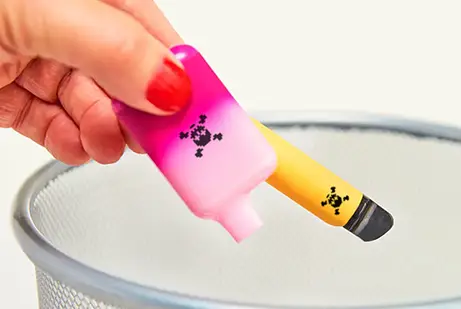
Toss anything that might tempt you in your room, your car, your backpack—basically everywhere.

Tough moments will pop up, especially in the first weeks. Knowing this ahead of time makes them easier to handle.

Ask friends not to vape around you. Being around it can make quitting harder—make it easier on yourself.

Remember why you’re quitting: better health, more money, feeling like yourself again. Keep those reasons close.
.
Teens ages 13-17 can quit nicotine with parental consent, and for free, right from their phone.

A 90-day text-based program that is fun, easy to navigate, and teaches the skills to quit nicotine for good.

Participants receive daily text messages and interactive online content including videos, quizzes, and podcasts.

Participants can also receive 24/7 text support by texting keywords such as STRESS, BOOST, or OOPS, and have access to a quit coach with the keyword COACH.

Get smarter about nicotine. Check the blog for quick, real, easy-to-get info.